A clear run for hot melt. What advantages can additively manufactured tools offer in extrusion?

A clear run for hot melt. What advantages can additively manufactured tools offer in extrusion?

Research at universities of applied sciences is practical and transfer-oriented: The potential of mutual cooperation between science and industry can be clearly seen in research projects such as Extrusion Molds in Additive Manufacturing – ExAM, which Stefan Roth, Professor of Product Development and Design at HSM and part of the Applied Plastics Technology (AKT) team, is currently implementing.

What is it all about? First of all, it makes sense to introduce extrusion as a special process in plastics technology: Basically, extrusion is a way of manufacturing „endless“ plastic parts such as pipes and hoses, although the actual method is also used in other contexts, for example in the production of pasta. In short, an extrusion line can be described as an apparatus that liquefies raw materials such as plastics, metals or foodstuffs and presses them through a nozzle – also known as a die – whereby this opening produces the shape of the product. In contrast to other processes, the outlet is continuous, which in turn brings with it specific possibilities, but also challenges. It is important to note that the complexity goes beyond the die and includes process steps such as cooling in addition to the melt. Before we turn our attention to the ExAM research project, which focuses on the advantages of additive manufacturing of tools such as the nozzle, we will first remain with the extrusion process.

The extrusion

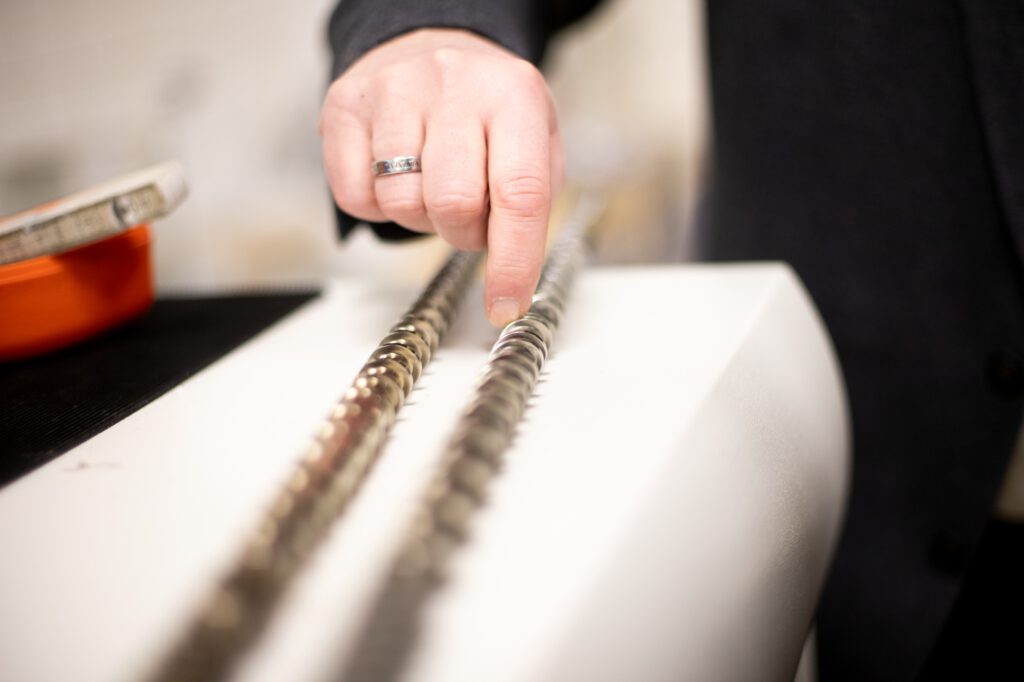
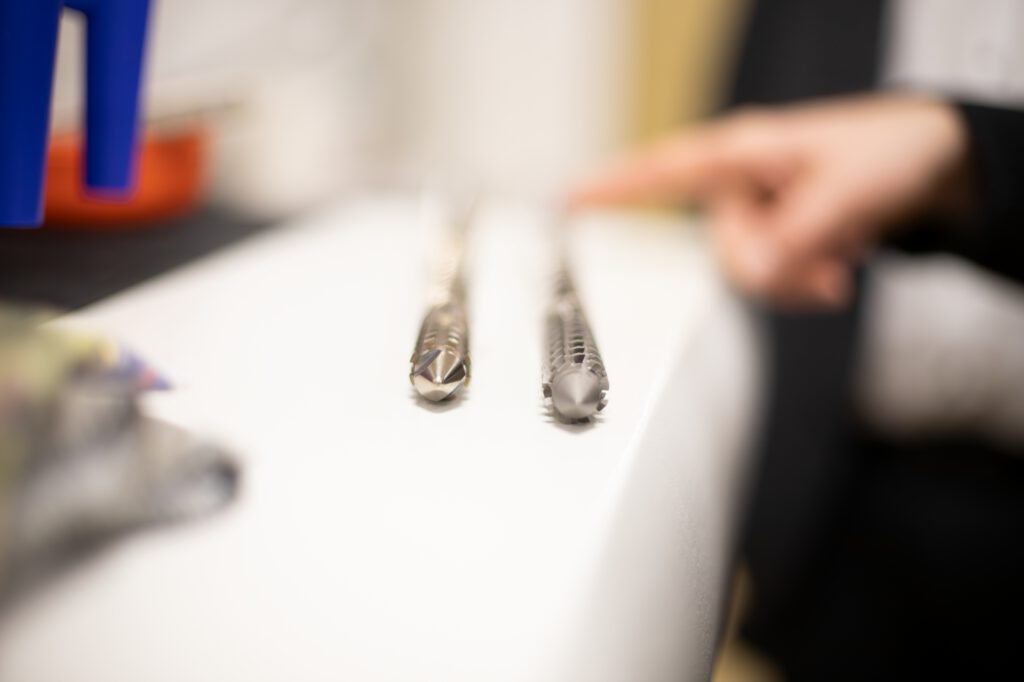
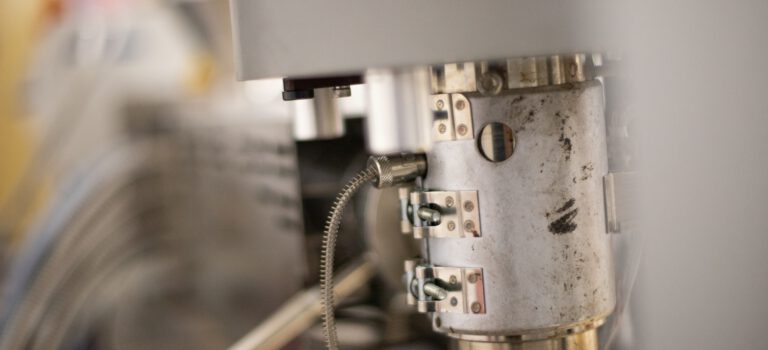
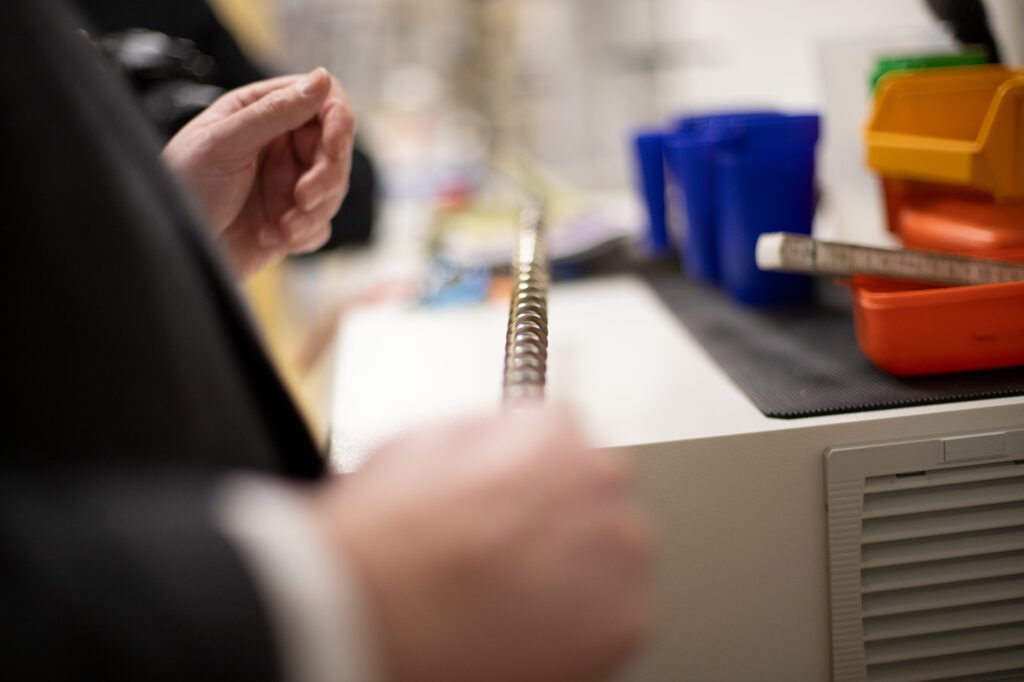
As already mentioned, extrusion is not a single machine, but can rather be understood as a system with various parts and stations. Let’s take a brief look at the path of the product: At the beginning is the raw material, i.e. the granulate, which is fed into the extruder via a hopper. This contains a screw that rotates and transports the material to the outlet, mixing, compacting and heating it in the process. The friction of the material generated by the screw movement produces heat, which melts the granulate. This melting process is promoted by heating belts attached to the outside of the system. 
This creates a melt, which is then kneaded and homogenized by the screw. The melt is then pressed through the nozzle and shaped into the desired form. The result is a basically endless molded part, as we know it, for example, as a cable duct, window profile or film.  The product is then cooled and simultaneously calibrated, whereby the processes differ depending on the characteristics of the product. The task is to avoid deformation caused by the thermoplastic properties of the material during cooling. At the end of the process, the continuous extrudate is cut to length or wound up. 

Optimization approaches

It is important to understand that it is not about a material, a process and a machine that ultimately creates a product, but that various parameters have a decisive influence on the possibilities and limits of the process and the product as well as its quality. For example, both the screw types and their processes (e.g. their rotation) have an impact on the melt: different screw types are suitable depending on the material. There are also variables such as quantity, speed and heat, as well as the role of additives, i.e. additives in addition to the granulate, which in turn have their own properties. All of these components must be coordinated depending on the material and product in order to achieve the most precise and efficient production possible at the end of the process. Especially for products that are typically manufactured by extrusion, the aspects of quantity are central. Due to the high quantities, improvements in production have enormous effects here.
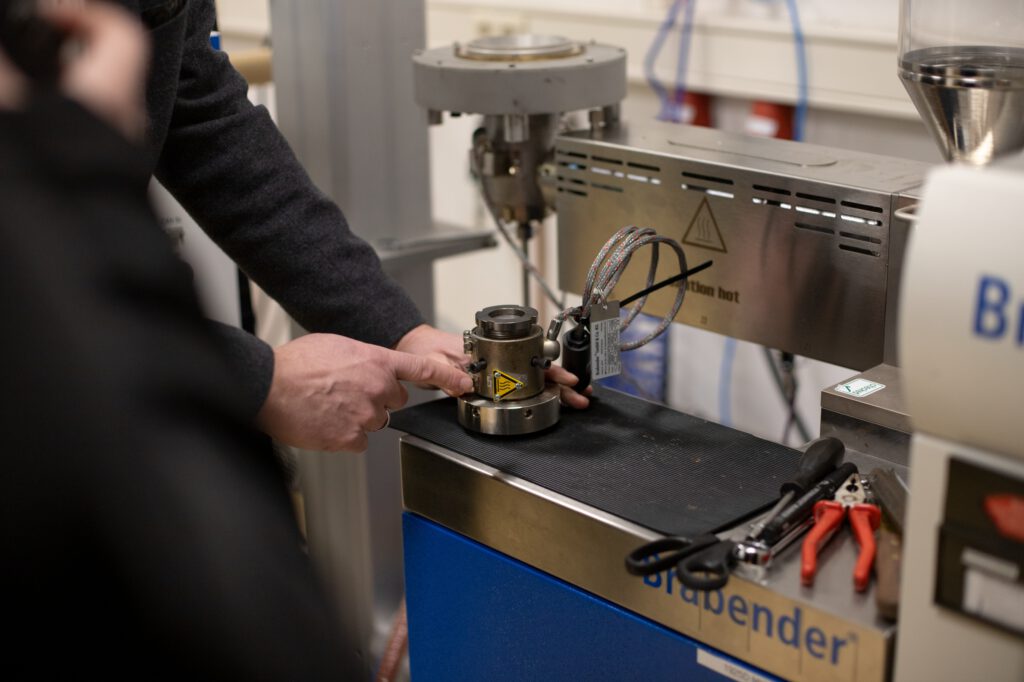
In such fundamental and generalizable areas, joint industrial research is a suitable vehicle for research projects. All participants can benefit from industrial collective research, IGF (Industrielle Gemeinschaftsforschung), projects and their results – without being held back by competitive pressure. In other words, this is an ambitious, pre-competitive cooperation that promotes research for mutual benefit. This community is supported by the Federal Ministry of Economics and Climate Protection and currently brings together 101 research associations and 1,200 research institutions. One of these research areas, represented by the Research Association of German Toolmakers, Forschungsgemeinschaft Deutscher Werkzeug- und Formenbauer FDWF e.V., concerns the question of whether and how the advantages of additively manufactured tools can be measured in the extrusion process. And that brings us to Schmalkalden University of Applied Sciences.

The research project

The ExAM research project shifts the focus away from conventionally manufactured tools, which are produced subtractively, i.e. cutting machining process, towards the process of additive manufacturing. This is already established in other areas – both in general and in the field of plastics production – and now the question arises as to whether these advantages can be transferred to the extrusion process. One obvious benefit is that additive processes offer more degrees of freedom in the production of tools, thus enabling new and innovative approaches to design.

Traditionally, the tools are manufactured using machining processes such as milling, turning or electrical discharge machining. A necessary consequence of this procedure is restrictions such as transitions and dead spaces, which have a negative impact on the flow of the melt. The layer-by-layer structure of additive manufacturing can avoid precisely these restrictions. The optimization of the tools then leads to an improvement in the products and the manufacturing process: better component properties and more dimensionally accurate parts are just as much goals as the more robust and simpler design of the processes. Among other things, the optical properties can be optimized and part rejects minimized. In short, engineers have more options when it comes to design: However, the question of whether the additional expense of additive manufacturing is worth it remains unanswered.
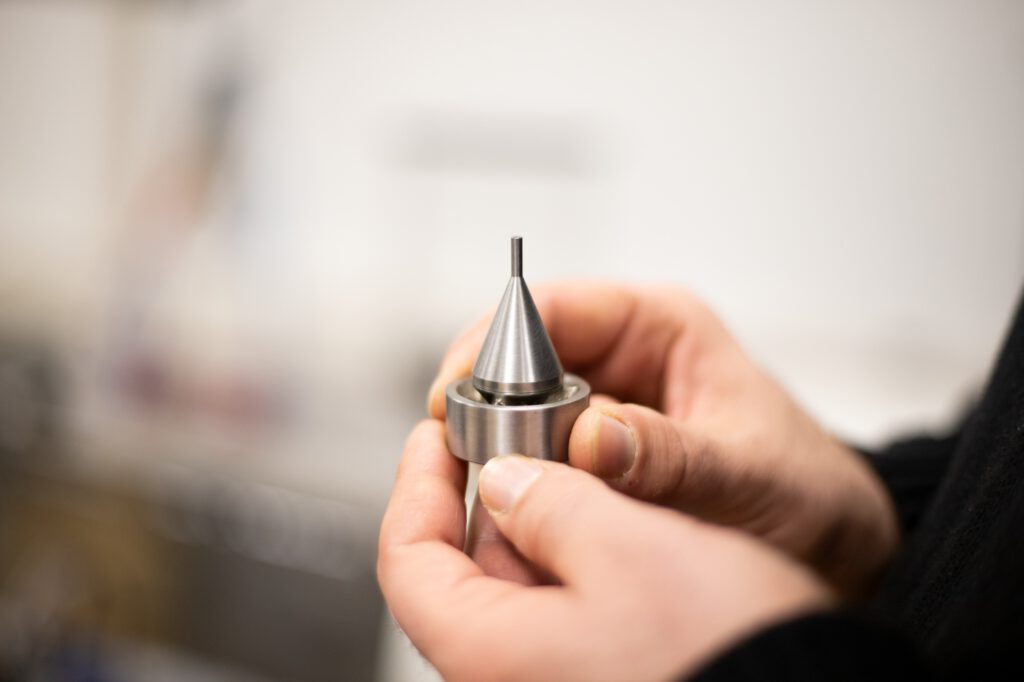
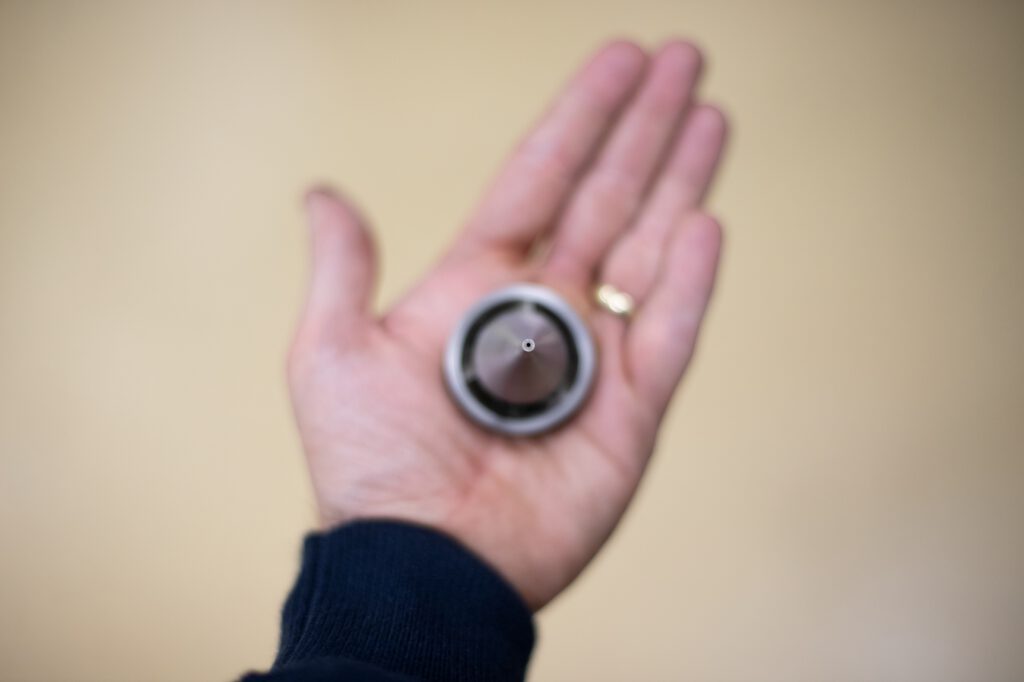
Let’s focus on the possibilities: The central point is the guidance of the melt in the mold, which should be guided as homogeneously as possible to the exit point and brought into shape. Stagnation, jams and dead spaces must also be avoided in terms of material quality, as these lead to streaks or color defects, among other things. The material that accumulates in dead spaces degrades over time, disrupts the flow and has negative effects on the mechanical and optical properties of the material. It is also important to control the speed of the melt, which in turn depends on the pressure and temperature. Additive manufacturing of the tools allows the implementation of targeted temperature control and therefore the best possible design of the melt channels and guidance. At the same time, innovative geometries in the form of cooling channels can be introduced into the tool.

The aim of the design is to optimize the melting chamber, allowing the fastest possible throughput while maintaining the same quality. The increase in efficiency can offer decisive advantages in mass production. This economic benefit in production, which additive components provide, is to be clarified in the ExAM research project. At the end of the project, in addition to evaluating the advantages, a guideline will be developed which will prepare the design and layout of additively manufactured components and be available to all cooperation partners. The companies can then use these guidelines to develop additive tools according to their own requirements and objectives. This basic accessibility means that the technology of additive manufacturing of tools can be widely applied, and the innovative impetus can be used to increase product quality features.

Innovative transfer

The use of additively manufactured and optimized tools is by no means new territory in the field of injection molding, but it is for the extrusion process. It is therefore less important to develop new technologies than to transfer existing ones to a new area. In this way, existing experience from injection molding can be used in aspects such as temperature and flow control of the melt. As a result of the fundamental application orientation, this topic lends itself as a cooperative project of industrial joint research (IGF), whereby all participating companies should be able to benefit from the technologies researched. As a project located here, the focus is on application proximity, i.e. the envisaged competitive advantages of the cooperating institutions and companies.

The two-year ExAM project started last fall and brings together three cooperation partners with three different spotlights: Schmalkalden University of Applied Sciences is focusing on extrusion and the field of health tech; Plastics Technology at Paderborn University is concentrating on the technical profile; and the Fraunhofer Institute for Additive Production Technologies, based in Hamburg-Bergedorf, is specializing in the project on the topic of simulation and additive manufacturing of tools using the laser-based powder bed process. 

The variety of shapes in the design made possible by the additive process is a challenge for HSM, as it opens up many new options. At the same time, however, this is also where the innovative optimization of the tools comes in. In addition to the actual shape of the component, various tool steels for the additive laser melting process are also being investigated, whereby the focus is always on types that are already commercially available. It is important that the subsequent use is uncomplicated. Last but not least, each individual optimization must take into account the entire process of the extrusion system and consider possible interactions.
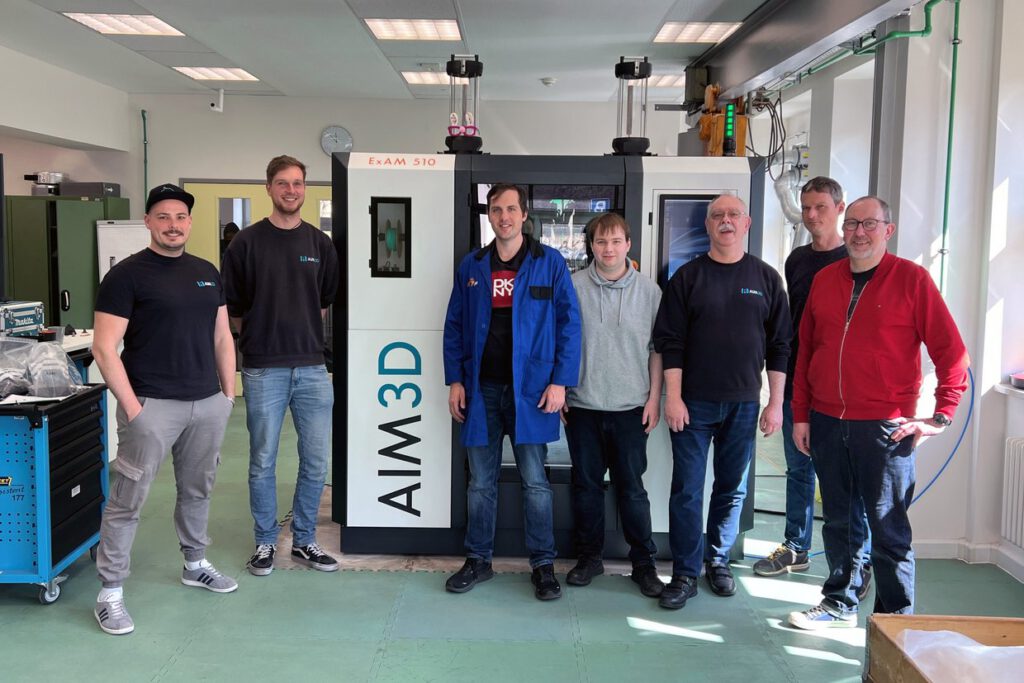
Team presenting the 3D printer

The Faculty of Mechanical Engineering and its research group of applied plastics technology (Angewandte Kunststofftechnik AKT) recently announced a new acquisition that can also support research on the ExAM project: The innovative 3D printer from the manufacturer NewAIM3D was successfully put into operation and is now available for research and teaching. This printer, based on the pellet direct extruder principle, makes it possible to directly and efficiently process plastics and compounds in commercially available pellet form. For example, printing with pellets consisting of metal powder and binder, so-called feedstocks, is possible. The resulting components are then sintered to achieve the density and properties of conventional steels. The process thus represents an alternative to the established but costly additive laser melting process for metal powders. The acquisition of the printer was made possible as part of the third funding period of the Thuringian Center for Mechanical Engineering and was funded by the Thuringian Ministry of Economic Affairs, Agriculture and Rural Areas. The Free State of Thuringia also supports the project, which is co-financed by the European Union as part of the European Regional Development Fund (ERDF).
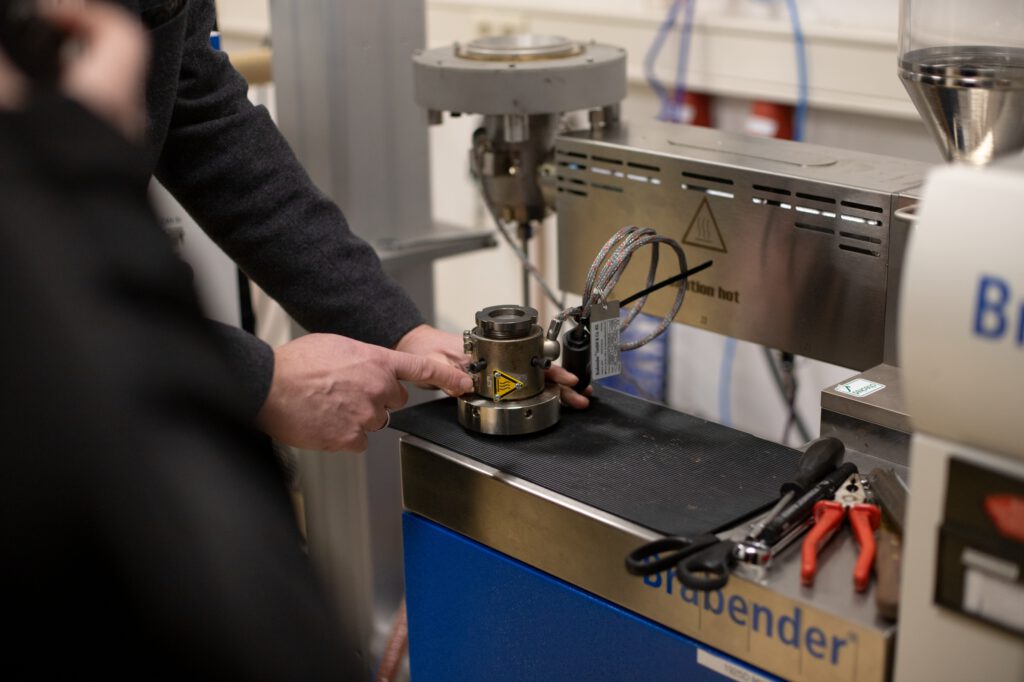
Freie Fahrt für heiße Schmelze. Welche Vorteile können additiv hergestellte Werkzeuge bei der Extrusion bieten?

Freie Fahrt für heiße Schmelze. Welche Vorteile können additiv hergestellte Werkzeuge bei der Extrusion bieten?

Forschung an Hochschulen angewandter Wissenschaften ist praxisnah und transferorientiert: Die Potentiale der wechselseitigen Kooperation von Wissenschaft und Wirtschaft können an Forschungsprojekten wie ExAM deutlich gemacht werden, das Stefan Roth, Professor für Produktentwicklung und Konstruktion an der HSM und Teil des Teams der Angewandten Kunststofftechnik (AKT), gerade umsetzt.

Um was geht es? Zunächst ist es sinnvoll, die Extrusion als ein spezielles Verfahren in der Kunststofftechnik vorzustellen: Grundsätzlich ist die Extrusion eine Möglichkeit der Fertigung von „endlosen“ Kunststoffteilen wie Rohre und Schläuche, wobei die eigentliche Methode auch in anderen Zusammenhängen angewandt wird, zum Beispiel bei der Herstellung von Nudeln. Kurz lässt sich eine Extrusionsanlage als eine Apparatur beschreiben, die Rohmaterialien wie Kunststoffe, Metalle oder Lebensmittel verflüssigt und durch eine Düse – auch Matrize genannt – presst, wobei diese Öffnung die Form des Produkts ergibt. Im Unterschied zu anderen Verfahren ist der Austritt kontinuierlich, was wiederum spezifische Möglichkeiten, aber auch Herausforderungen mit sich bringt. Wichtig ist dabei, dass die Komplexität über die Düse hinausgeht und neben der Schmelze unter anderem auch Prozessschritte wie die Abkühlung umfasst. Bevor wir uns dem Forschungsprojekt ExAM zuwenden, worin es um die Vorteile der additiven Fertigung von Werkzeugen wie der Düse geht, verbleiben wir zunächst beim Extrusionsprozess.

Die Extrusion

Wie bereits erwähnt ist die Extrusion keine einzelne Maschine, sondern lässt sich eher als eine Anlage mit verschiedenen Teilen und Stationen verstehen. Gehen wir kurz den Weg des Produktes: Am Anfang steht das Rohmaterial, also das Granulat, das über einen Befülltrichter in den Extruder eingeführt wird. In diesem befinden sich eine Schnecke, die sich dreht und das so Material zum Ausgang transportiert und es dabei vermengt, verdichtet und erwärmt. Durch die in der Schneckenbewegung entstehende Reibung des Materials wird Wärme produziert, durch welche das Granulat aufgeschmolzen wird. Dieser Schmelzprozess wird durch außen auf der Anlage angebrachte Heizbänder gefördert.

So entsteht eine Schmelze, die im weiteren Gang durch die Schnecke verknetet und homogenisiert wird. Die Schmelze wird dann durch die Düse gepresst und so in die gewünschte Form gebracht. So entsteht ein im Grunde endloses Formteil, wie wir es zum Beispiel als Kabelschacht, Fensterprofil oder Folie kennen.  Im Anschluss wird das Produkt abgekühlt und simultan kalibriert, wobei sich hier die Verfahren je nach Eigencharakteristik des Produkts unterscheiden. Die Aufgabe ist es, Verformungen zu vermeiden, die durch die thermoplastischen Eigenschaften des Materials beim Abkühlen entstehen. Am Ende des Prozesses wird das endlose Extrudat abgelängt oder aufgewickelt.

Ansätze der Optimierung

Wichtig ist zu verstehen, dass es nicht um ein Material, ein Verfahren und eine Maschine geht, durch die letztendlich ein Produkt entsteht, sondern verschiedene Parameter die Möglichkeiten und Grenzen des Prozesses und des Produkts sowie deren Qualität entscheidend beeinflussen. Zum Beispiel haben sowohl die Schneckentypen als auch ihre Verfahrensweisen (z.B. ihre Rotation) Auswirkungen auf die Schmelze: Je nach Material eignen sich andere Schneckentypen. Variablen wie Menge, Geschwindigkeit und Wärme kommen hinzu, aber auch die Rolle von Additiven, also Zusätzen neben dem Granulat, denen wiederum eigene Eigenschaften zukommen. All diese Komponenten müssen je nach Material und Produkt abgestimmt werden, um am Ende des Prozesses eine möglichst passgenaue und effiziente Produktion zu realisieren. Gerade für Produkte, wie sie typischerweise mittels Extrusion hergestellt werden, sind die Aspekte der Quantität zentral. Durch die hohen Stückzahlen haben hier Verbesserungen der Produktion enorme Effekte.

In solchen grundlegenden und generalisierbaren Bereichen bietet sich die industrielle Gemeinschaftsforschung als Träger von Forschungsprojekten an. Von den IGF-Projekten und dessen Ergebnissen können alle Beteiligten profitieren, ohne hier von dem Konkurrenzdruck ausgebremst zu werden. Anders formuliert geht es hier um eine ambitionierte, vorwettbewerbliche Kooperation, die Forschung zum gemeinsamen Nutzen fördert. Getragen wird diese Gemeinschaft vom Bundesministerium für Wirtschaft und Klimaschutz, sie verbindet aktuell 101 Forschungsvereinigungen und 1200 Forschungseinrichtungen. Einer dieser Forschungsbereiche, repräsentiert durch die Forschungsgemeinschaft Deutscher Werkzeug- und Formenbauer FDWF e.V., betrifft die Frage, ob und wie sich die Vorteile additiv gefertigter Werkzeuge im Extrusionsverfahren bemessen lassen. Und damit sind wir an der Hochschule Schmalkalden.

Das Forschungsprojekt

Das Forschungsprojekt ExAM rückt den Fokus weg von klassisch hergestellten Werkzeugen, die subtraktiv gefertigt werden, hin zum Verfahren der additiven Fertigung. Dieses ist in anderen Bereichen – sowohl im Allgemeinen als auch auf dem Gebiet der Kunststofffertigung – schon etabliert, und nun stellt sich die Frage, ob sich diese Vorteile auf das Verfahren der Extrusion übertragen lassen. Ein auf der Hand liegender Nutzen ist, dass die additiven Verfahren mehr Freiheitsgrade bei Fertigung der Werkzeuge bieten, und somit neue bzw. innovative Ansätze der Konstruktion ermöglichen.

Klassisch werden die Werkzeuge in Zerspanungsverfahren wie dem Fräsen, oder Drehen gefertigt, poliert und die Komponenten anschließend zusammengebaut. Eine notwendige Folge dieses Vorgehens sind Restriktionen wie Übergänge und Toträume, die negative Auswirkungen auf den Fluss der Schmelze haben. Der Schicht-für-Schicht-Aufbau der additiven Fertigung kann eben diese Restriktionen vermeiden. Die Optimierung der Werkzeuge führt dann zu einer Verbesserung der Produkte bzw. des Fertigungsprozesses: Bessere Bauteileigenschaften und maßhaltigere Teile sind ebenso Ziele wie die robustere und einfachere Ausgestaltung der Prozesse. So lassen sich unter anderem die optischen Eigenschaften optimieren auch der Ausschuss von Teilen minimieren. Kurzum haben Ingenieur:innen bei der Konstruktion mehr Möglichkeiten: Offen ist hingegen die Frage, ob sich der Mehraufwand der additiven Fertigung lohnt.

Bleiben wir bei den Möglichkeiten: Der zentrale Punkt ist die Führung der Schmelze im Werkzeug, die möglichst homogen zum Austrittspunkt geleitet und in Form gebracht werden soll. Stockungen, Stausituationen und Toträume müssen auch aus Sicht der Materialqualität vermieden werden, führen diese doch unter anderem zu Schlieren oder farblichen Mängeln. Das sich in Toträumen ansammelnde Material degradiert mit der Zeit, stört den Fluss und hat negative Effekte auf die mechanischen und optischen Eigenschaften des Materials. Wichtig ist ferner die Kontrolle der Geschwindigkeit der Schmelze, was wiederum in Abhängigkeit zum Druck und der Temperatur steht. Die additive Fertigung der Werkzeuge erlaubt die Umsetzung einer gezielten Temperierung, und somit die bestmögliche Auslegung der Schmelzekanäle und -führung. Zugleich lassen sich innovative Geometrien in Form von Kühlkanälen in das Werkzeug einbringen.

Ziel der Konstruktion ist die Optimierung des Schmelzraums, die eine möglichst schnelle Durchleitung bei gleichbleibender Qualität erlaubt. Die Effizienzsteigerung kann bei der Massenproduktion entscheidende Vorteile bieten. Dieser ökonomische Nutzen in der Produktion, den die additiven Bauteile liefern, soll im Forschungsprojekt ExAM geklärt werden. Am Ende des Projektes steht neben der Bewertung der Vorteile die Entwicklung eines Leitfadens, der die Konstruktion und die Auslegung additiv gefertigter Bauteile aufbereitet und allen Kooperationspartnern zur Verfügung steht. Anhand dieses Leitfadens können die Unternehmen dann gemäß ihrer eigenen Ansprüche und Ziele additive Werkzeuge entwickeln. Durch diese grundlegende Zugänglichkeit kann die Technologie der additiven Fertigung von Werkzeugen breit in Anwendung gebracht und die innovativen Impulse für die Steigerung der Produktqualitätsmerkmale genutzt werden.

Innovativer Transfer

Die Nutzung von additiv gefertigten und optimierten Werkzeugen ist im Bereich des Spritzgusses keineswegs Neuland, aber für das Verfahren der Extrusion schon. Somit gilt es weniger, neue Technologien zu entwickeln als darum, schon vorhandene in ein neues Gebiet zu übertragen. So lassen sich die bereits vorhandenen Erfahrungen aus dem Spritzguss in den Aspekten wie der Temperierung und der Flussführung der Schmelze nutzen. Infolge der grundlegenden Anwendungsorientierung bietet sich dieses Thema als kooperatives Projekt der industriellen Gemeinschaftsforschung (IGF) an, wobei von den erforschten Technologien alle beteiligten Unternehmen profitieren können sollen. Als ein hier angesiedeltes Projekt steht die Anwendungsnähe im Fokus, also die anvisierten Wettbewerbsvorteile der kooperierenden Institutionen und Unternehmen.

Das zweijährige Projekt ExAM startete im letzten Herbst und verbindet drei Kooperationspartner mit drei unterschiedlichen Schwerpunkten: Im Fokus der Hochschule Schmalkalden steht die Extrusion und das Feld der Health Tech, die Kunststofftechnik der Universität Paderborn konzentriert sich auf das technische Profil; und das Fraunhofer Institut für additive Produktionstechnologien mit Sitz in Hamburg-Bergedorf ist im Projekt auf das Thema der Simulation und additiven Fertigung der Werkzeuge im laserbasierten Pulverbettverfahren spezialisiert.

Die durch das additive Verfahren ermöglichte Formvielfalt in der Konstruktion ist dabei für die HSM eine Herausforderung, ergeben sich doch viele neue Optionen. Zugleich setzt hier aber auch die innovative Optimierung der Werkzeuge an. Neben der eigentlichen Form das Bauteils werden auch verschiedene Werkzeugstähle für das additive Laserschmelzverfahren untersucht, wobei es immer um bereits kommerziell verfügbare Typen geht. Wichtig ist die Unkompliziertheit der anschließenden Nutzung. Nicht zuletzt muss jede einzelne Optimierung den gesamten Prozess der Extrusionsanlage mitbedenken und eventuelle Wechselwirkungen in Betracht ziehen.

Team bei der Vorstellung des 3D-Druckers

Jüngst konnte die Fakultät Maschinenbau und das AKT eine Neuanschaffung vermelden, die auch die Forschung am ExAM-Projekt unterstützen kann: Der innovative 3D-Drucker des Herstellers NewAIM3D wurde erfolgreich in Betrieb genommen und steht nun für Forschung und Lehre bereit. Mit diesem Drucker nach dem Pelletdirektextruderprinzip ist es möglich, Kunststoffe, Compounds, in handelsüblicher Granulatform direkt und effizient zu verarbeiten. So wird beispielsweise der Druck mit Granulaten, bestehend aus Metallpulver und Binder, sogenannten Feedstocks, möglich. Die daraus entstehenden Bauteile werden anschließend gesintert und erlangen so die Dichte und Eigenschaften von konventionellen Stählen. Das Verfahren stellt so eine Alternative zum etablierten jedoch aufwändigen additiven Laserschmelzverfahren von Metallpulvern dar. Die Anschaffung des Druckers wurde im Rahmen der dritten Förderperiode des Thüringer Zentrums für Maschinenbau ermöglicht und durch das Thüringer Ministerium für Wirtschaft, Landwirtschaft und ländlichen Raum gefördert. Zudem unterstützt der Freistaat Thüringen das Vorhaben, das durch Mittel der Europäischen Union im Rahmen des Europäischen Fonds für regionale Entwicklung (EFRE) kofinanziert wird.

In Kürze wird an dieser Stelle noch ein Video eingestellt, dass die Allianz Thüringer Ingenieurwissenschaften zu diesem Projekt produziert hat.