The summer of 2026 once again brought home to us the consequences of climate change: a prolonged drought and intense heatwaves not only caused several thousand heat-related deaths, but also led to ecological and economic disruption, such as the restricted usability of waterways. Efforts towards a comprehensive transformation towards ‘sustainability’ have thus regained relevance and momentum. It is important not to limit this transformation to the transport and energy sectors, but to view it as a holistic project.
Another key lever is industry, which holds great potential for ecological transformation. A start has already been made here with emissions trading and its incentive effect: environmental pollution is linked to compensation payments, and by limiting the number of allowances issued, prices – and thus costs – are driven ever higher. Consequently, it is becoming increasingly worthwhile for industry to align itself with the principles of sustainability.
Cement production faces particular challenges in this regard: the cement industry is a major emitter of carbon dioxide, which plays a key role in global warming. If this sector were a country, its CO₂ emissions would rank third after China and the United States. This means there is enormous scope for innovative approaches and economies of scale in this area.

Application: Cement works
To start at the beginning: due to its material properties, such as strength and durability, and its widespread global availability, cement and concrete are among the most widely used materials. In cement works, limestone and clay (and, in some cases, corrective materials) are ground into a raw meal and then heated to around 1,450 °C. The materials partially fuse during this process, producing what is known as cement clinker. This is then processed into the final product, to which various materials with specific properties can be added, depending on the intended application.
This production process releases large quantities of the carbon dioxide bound in the limestone, which, at 2.7 billion tonnes, accounts for around 8 per cent of humanity’s total emissions. The industry’s motivation to minimise this immense pollution is evident.
One approach is the chemical capture of carbon dioxide from the exhaust air. On the one hand, this process is already well-established; on the other, it is complex and, due to high energy costs, not particularly efficient. In any case, the result is carbon dioxide in liquid form, which in turn can be stored underground. This saves companies the cost of purchasing some of their emission allowances, which is becoming increasingly attractive due to the automatic rise in prices.
The team behind the ‘CO₂ Separation’ project is pursuing a different approach: according to Harshil Mistry, Manuela Rios and Martin Elsmann, the conversion is to be driven not by chemical processes, but by special membranes that filter the carbon dioxide out of the exhaust air. This process is also already established in industry. To address the issue of low efficiency here, the team intends to draw on a promising innovation from the field of chemistry: MOFs.

The astonishing extent of internal surface area
MOF is the abbreviation for metal-organic frameworks: in 2025, scientists Prof. Omar M. Yaghi (University of California), Prof. Susumu Kitagawa (Kyoto University) and Prof. Richard Robson (University of Melbourne) were awarded the Nobel Prize in Chemistry for this approach to producing specific chemical compounds. Based on an idea from the late 1950s, the breakthrough in reticular (network-like) chemistry did not come until almost forty years later: the use of different components massively increased the stability of the frameworks, which made their practical application possible in the first place.
MOFs consist of inorganic nodes and organic molecules that serve as linking elements (linkers). Their composition is variable and is characterised by the respective properties and distinctive features of the structures. The innovative potential of these crystalline materials could offer solutions to pressing problems of our time: MOFs function like sponges and can absorb carbon dioxide and water from the air. Both environmental pollution caused by the greenhouse gas carbon dioxide and a future water shortage could be addressed using this approach.
It is precisely the porosity of MOFs that enables these frameworks to absorb these substances in massive quantities. The small size of these molecules has made it impossible for other approaches to develop successful solutions in this area. Nanoporous MOFs form in crystalline form and have an immense internal surface area. A single gram of MOF-200 has an internal surface area of 6,000 square metres, whilst MOF-210 increases this to over 10,000 square metres. This would be the area of a standard football pitch, which could fit inside a single sphere of MOF-210. Because the material thus offers an enormous amount of space, it is ideally suited to the absorption, filtration and storage of gases.
As already mentioned, there is not just one MOF, but many different types with varying compositions and material properties. Not only are established MOFs being continuously improved and adapted to their specific tasks, but research is also continuing into the few remaining unstable compounds. In the case of CO₂ storage, the aim is to optimise storage capacity, create robust structures and ensure long-lasting absorption and release processes. At the same time, the material must also demonstrate resilience to factors such as water, chemicals and heat that arise during the process.
BASF has now succeeded in producing MOFs on an industrial scale and utilising them for CO₂ capture. This has demonstrated, in principle, that MOFs can be produced in quantities sufficient to enable the industrial transformation required. Such industrial upscaling is a step that still lies some way off for the research project at HSM. And in the final section, we will not only look at the innovative approach of the Schmalkalden project, but also at how the topics of cement works and MOFs can be linked: with the help of so-called mixed-matrix membranes.

Complex tasks, complex membranes
The filtration of exhaust gases is carried out using membranes. Whilst conventional, pure polymer membranes can perform the separation in an energy-efficient manner, these processes are limited when it comes to balancing selectivity and permeability. In other words, it is not always possible to optimise both the flow of gases and the filtration of specific substances. Furthermore, the performance of the membranes also declines over time.
Mixed-matrix membranes combine an organic polymer with a porous additive, effectively introducing a second phase into the membrane. In MMMs, gas permeation can be achieved just as efficiently as the precise and adaptable separation of specific molecules, which represents a decisive advantage. At the same time, this process requires only a fraction of the energy used in conventional industrial separation processes. In an industrial context, it is important to be able to ensure the longevity of the materials: ideally, the membranes should therefore be defect-free, selective and highly permeable, as well as being resistant to high thermal, mechanical and chemical stresses.
Alongside other materials, the porous additive can also be formed from MOFs, whereby the immense porosity offers just as much of an advantage as the energy-efficient release of the molecules stored in the pores, for example in comparison with zeolites. It is important not only to find the right MOF for the task at hand, but also to ensure its processability in the context of an MMM.

The ‘CO₂ Separation’ project
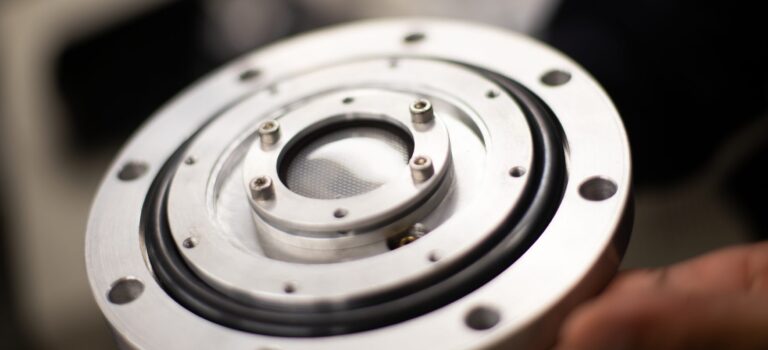
And this is, not least, a challenge that the team behind the “CO₂ Separation” project is tackling. Another task, very much in keeping with the ethos of an application-oriented university, is to develop the technology in such a way that it can be integrated into existing plants with minimal effort. At the same time, the installation and maintenance offer potential for a dedicated business division. Before that can happen, however, the fundamental technological challenges must first be overcome. Now that the first MOFs have been produced and initial tests with a membrane provided by the Fraunhofer IKTS Institute in Hermsdorf have been successfully completed, the next step is to develop a system for printing the membrane in order to manufacture MMMs. The next challenge is to master the complex process of printing the membrane and to guarantee its quality.
The ‘CO₂ Separation’ project is funded by the ‘exist’ programme of the Federal Ministry for Economic Affairs and Energy and by the European Union through the European Social Fund Plus. The ‘exist’ funding programme of the Federal Ministry for Economic Affairs and Energy (BMWE) aims to transform scientific and technological innovations from universities and research institutions into successful, marketable start-ups. In doing so, it supports those interested in setting up a business through financial assistance, coaching and networking, amongst other things, to help develop start-up projects and strengthen Germany’s innovation and competitiveness.
The ‘CO₂ Separation’ research project exemplifies how important an interdisciplinary approach is for tackling complex challenges such as climate change. The development of innovative membranes combines fundamental chemical research with questions relating to materials science, engineering implementation and economic expertise – all of which are crucial for transforming technological innovations into viable business models and establishing a start-up. At the same time, the project highlights the potential inherent in the diversity of disciplines at Schmalkalden University of Applied Sciences (HSM): where different disciplinary perspectives converge, scientific findings can give rise to application-oriented solutions that combine environmental responsibility with technological innovation and entrepreneurial thinking. In this way, interdisciplinary collaboration becomes a key building block for translating research into concrete contributions to sustainable transformation.