This summer, the Faculty of Electrical Engineering at Schmalkalden University of Applied Sciences hosted the E-Science Day for the fifth time. The aim of this event is to offer both the university community and the wider public an insight into the breadth of the faculty’s subject areas and its current research. Much of what happens in science may seem distant at first, but is actually very close to people’s everyday lives.
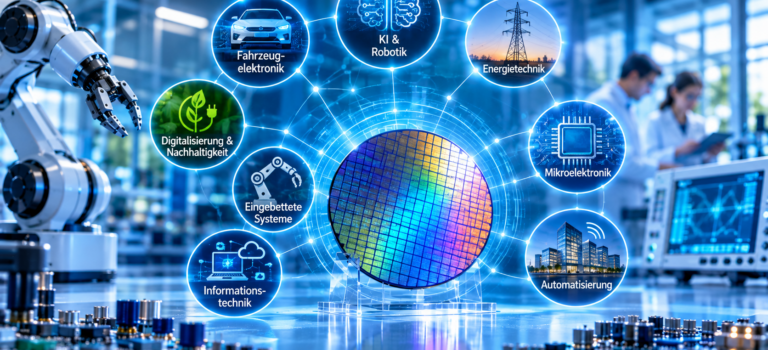
Electrical Engineering at Schmalkalden University of Applied Sciences covers a broad spectrum of modern technologies – ranging from electrical power engineering and automation, through vehicle electronics and embedded systems, to microelectronics, autonomous systems and information technology. In doing so, the faculty combines traditional engineering disciplines with future-oriented topics such as digitalisation, AI, robotics, the energy transition and modern electronics – in a practical, innovative way and with a focus on specific applications.
From construction monitoring
Professor Maria Schweigel presented her BauKIRo project, ‘Automatic monitoring of construction progress through the application of artificial intelligence and robotics’, which ran for three years and has now been completed. The aim was to improve the monitoring of building structures under construction. To date, construction progress and adherence to the schedule have been checked manually, which is a time-consuming and costly process. At the same time, the earlier corrections are identified and addressed in the construction process, the more cost-effective they are.
The approach taken by the BauKIRo project was to develop a drone capable of carrying out monitoring tasks autonomously and precisely with the aid of artificial intelligence. This solution has the advantage of combining low costs with continuous monitoring of the building site, whilst also not disrupting construction progress, as the drone can carry out its monitoring even at night.
The Building Information Model (BIM) was utilised for the inspection; this not only enabled the comparison of plans with the actual situation but also facilitated the coordination of movement within the construction site. One problem encountered was that the BIM was available in various formats, which complicated data processing. As GPS does not function reliably enough indoors and solutions using other sensors were also inadequate, the project team opted for a semantics-based localisation approach: distinctive features such as door frames served as orientation points for positioning, enabling an accuracy of less than 10 cm to be achieved.
A practical challenge during implementation was precisely this movement of the drone within an active construction site: paths may be blocked, cables may be hanging down, or many other contingencies may hinder the drone’s exploration. It was therefore necessary to implement protective measures without placing too great a burden on the drone’s weight and, consequently, its range. This required striking a balance between safety and factors such as range, which presented a challenge both in the design of the drone and in the selection of sensors and image recognition hardware.
In addition to tracking movement within the rooms, a further challenge lay in generating and converting the images – in the form of point clouds – into three-dimensional representations of buildings, which could then be aligned with the BIM model. Achieving the most accurate representation possible was just as labour-intensive as detecting unknown objects (including machinery). These had first to be identified and then excluded during the alignment process with the BIM model. As there are no relevant datasets available to guide artificial intelligence applications in recognising such objects within the ‘construction site’ context, customised solutions – such as a specialised deep learning network – had to be developed here too.
The project succeeded in creating a functional demonstrator capable of meeting the requirements of active construction sites. Future projects can build on this and expand the possibilities to include increasingly complex technologies and AI applications. In addition to Schmalkalden University of Applied Sciences, the Friedrich-Alexander University of Erlangen-Nuremberg participated in BauKIRo. At the same time, it was an IGF project and was funded via the DLR Project Management Agency – German Aerospace Centre (DLR) – with funding from the then Federal Ministry for Economic Affairs and Climate Action (BMWK).
And the development of evacuation aids
Following the completion of this project, attention turned to a venture that is still in its infancy: EvacEye – No Life Unseen. With the aim of successfully participating in the Cosima competition, students at Schmalkalden University of Applied Sciences are tackling an important issue: preventing casualties in the event of a fire. In the event of a fire, time is a critical factor, and every gain in time can help to facilitate evacuations and save lives. To date, the fire service has relied on manual procedures during operations, using floor plans to prioritise and work through areas based on the estimated number of people present. The idea behind the project is to provide the fire service with early information on the number and distribution of people in the event of an emergency, thereby optimising evacuation procedures.
In doing so, the project had to take into account the harsh environmental conditions, such as those caused by smoke and darkness. Instead of a camera-based solution, radar and thermal sensors are to be used to detect the presence of people through the combined detection of heat and movement. A low resolution is sufficient here to enable reliable detection of people. This solution also has the major advantage of posing no data protection concerns and, from the end-users’ perspective, causing far less hesitation. In the event of a fire, the system is activated and transmits its measurements to the emergency services, who can then take appropriate action.
At the end of the year, the team led by Leonard Maletzke, Luis Marcus, Karl Schwennicke Plata and Marius Weimann will present their project at the electronica trade fair in Munich.
On MEMS integration and chip interconnection
These two presentations were followed by a talk focusing on the specific field of wafer bonding, a process in which two ultra-thin semiconductor wafers are permanently bonded together to produce more complex electronic or micro-engineering components. The process is a key technology for applications such as microchips, sensors, power electronics and microsystems engineering, as it enables different materials and functional layers to be combined with precision and in a compact manner.
Arti Rana, a research assistant at Schmalkalden University of Applied Sciences, examined a specific method for sealing and integrating microelectromechanical systems (MEMS) – known as anodic bonding – and investigated the properties of a specific material. In anodic bonding, glass is used to create the connection, the hermetic seal and the encapsulation of the components. The material used for this purpose must possess specific properties and meet quality standards in order to be suitable for these applications.
Arti Rani investigated the specific behaviour of a new glass from Schott, Borofloat 33 HT, in comparison with the company’s standard glass. Particularly for industrial upscaling, the material properties must be examined in detail; this concerns not only behaviour during the production process – i.e. bonding – but also medium- and long-term durability.
Macjonathan Okereke, who is also a research assistant at Schmalkalden University of Applied Sciences, presented his research into so-called under-bump metallisation (UBM), which must also possess specific material properties. In short, his work focuses on direct soldering for the assembly and connection of chips to printed circuit boards. In order to solder chips sawn from the wafer directly onto printed circuit boards as a modern alternative to traditional chip and wire bonding in packages (important for the smallest form factors), without using a surrounding encapsulation, specially adapted contact points are required: one option is the application of small solder balls, via which the connection to the component is then established. Macjonathan Okereke’s work focuses on the area beneath the balls, and thus the connection to the wafer. Under-bump metallisation consists of thin metal layer systems on the semiconductor chip which serve as a stable bridge, a bonding agent and a protective layer between the chip’s aluminium or copper contacts and the solder bumps; it is used in certain interconnection and integration processes and constitutes a directly solderable chip metallisation.
However, this method has so far relied on an electroplating process, which is neither environmentally sustainable nor cost-effective. The aim of this work was to demonstrate that sputtering processes are also suitable. In this process, material is removed from a target under vacuum and deposited as an ultra-thin layer onto a wafer – for example, to coat surfaces with metals or other materials for the purpose of forming contacts. As the study shows, this method is suitable for the production of high-quality UBMs and is therefore a more environmentally friendly and cost-effective alternative to electroplated coating systems.
Right through to drones and humanoid robots
Dr. Vitas Grimaila is an associate professor in the Department of Electrical Engineering at Kaunas University of Technology (KTU), a close partner of HSM, and specialises in the field of drone defence and the development of corresponding systems. Drones have long been a central component of armed conflicts and will therefore play a major role in future security measures. The development of drone technology is just as dynamic as the variety of their designs.
Drone defence systems are tasked with addressing this complexity and minimising the threat posed by drones. To do so, these systems must operate with precision, reliability and speed. The first step is detection, achieved through a combination of various sensors, including those that detect radio waves and propeller signatures. The drone must then be identified or classified in order to rule out false detections and initiate appropriate countermeasures. By tracking the drone and processing telemetry data, its movements are calculated and a favourable opportunity for interception is identified. The final stage is the interception, which ranges from disrupting the flight path to interrupting communication between the drone and the satellite navigation system. For the countermeasures to be effective, it is crucial that the drone is correctly classified.
André Lopes and Professor Christoph Menz presented a project dedicated to a novel approach to instructing humanoid robots, in this case the training of movements. The movement sequences for these robots are extremely complex, due, amongst other things, to the difficult coordination of numerous joints and motors. The project’s ambitious aim was to enable robots to learn movements via video, rather than having to input them laboriously. A key challenge in this endeavour lay in coordinating the various components and processes, and in avoiding movements that could cause damage.
To solve this problem, it proved useful to separate two areas: firstly, a catalogue (dataset) of possible and safe robot movements was created in the form of vectors. At the same time, a motion recognition system was developed that focuses on the intention behind the movement – in other words, the goal to be achieved. The robot was therefore designed to recognise and replicate the movement in the video, drawing on the catalogue of possible actions whilst imitating it. In doing so, particular emphasis was placed on flexibility: the optimal combination of movement sequences is calculated in real time and can react to factors such as obstacles in the path.
Outlook and Conclusion
Following this, Dominik Müller from the Sonneberg-based company HySON and Professor Martin Schreivogel presented the latest developments in hydrogen research. As a new teaching and research facility was also unveiled during this session, we will address this topic in a separate article.
The examples from E-Science Day impressively demonstrate just how diverse and application-oriented research is at the Faculty of Electrical Engineering at Schmalkalden University of Applied Sciences. Whether intelligent drones, digital construction sites, modern semiconductor technologies, innovative sensor systems or adaptive robots – the projects presented combine scientific fundamentals with specific challenges from industry and society. It is precisely this connection that highlights the contribution that application-oriented research can make at the university: it generates new knowledge, develops practical solutions from it and, at the same time, opens up new perspectives for future technologies.