The digitalization of society is not limited to smartphones; rather, it is driving comprehensive transformation across a wide range of sectors through trends such as the automation of mobility, smart energy management, and Industry 4.0. Even though we are accustomed to thinking in terms of “higher, further, and faster” in the digital realm—as exemplified by the demands on data volumes and transmission rates—there are also areas of application that are guided by opposing imperatives.
On the one hand, the idea of sustainability is becoming increasingly widespread, as evidenced, among other things, by the understanding of energy as a valuable, finite resource; on the other hand, the thoughtless waste of energy is certainly still an issue that manifests itself in various areas, such as the use of generative artificial intelligence. Beyond the broader societal context, however, there are also many other reasons to use resources such as energy or data consciously and efficiently.

Technologies that are, for example, geared toward principles of energy efficiency are already useful today: In addition to cash payments, credit cards, smartphones, and smartwatches are now widely used as payment options in everyday life. Even though this method of payment appears quite simple on the surface, it is based on complex technologies that simultaneously ensure the necessary security. Energy efficiency is an important aspect here, enabling secure communication over short distances.
What is communications engineering?
Electrical engineering, more specifically the field of communications engineering, deals with the question of how information is transmitted. In short, this involves the acquisition, conversion, transmission, switching, storage, and output of signals carrying information. The focus is on transmitting information as accurately as possible, with challenges arising not only at the signal input and output but also along the transmission path and in dealing with interference. In other words, this can be understood as the field of information and communication technology in the context of the technical infrastructure of a digital society.
The scope of this engineering discipline has expanded significantly in the course of the transition from analog to digital technology. At the same time, the emergence of modern information societies presents genuine challenges that require various technological solutions. On the one hand, this involves building a high-performance network infrastructure, as required by many sectors, such as autonomous logistics. The vast amounts of data and the need for real-time availability (as well as processing) demand optimal use of transmission technologies, channel capacities, and bandwidths to enable communication. On the other hand, there are application areas such as the aforementioned payments via debit cards and key cards (e.g., in car-sharing), where the focus is on authentication and security, combined with low energy consumption.
Signal-to-Noise Ratio
The general goal in telecommunications is the transmission of information by sending a signal from the transmitter to the receiver with as little interference as possible. A relevant factor here is the signal-to-noise ratio: the greater the ratio, the more distinct the difference between the signal and interfering influences—such as overlapping ambient noise—becomes, allowing the information to be received more clearly. There are two ways to minimize these signal impairments: One approach involves reducing or filtering out the interfering factors. The other classic method involves amplifying the signal carrying the information. In both cases, the signal-to-noise ratio is increased and the desired signal becomes clearer.
It should be noted that, depending on the level of amplification, power consumption—and thus energy requirements—increases. Consequently, this factor must be considered, particularly in applications where energy is very limited. Depending on the application area, it is therefore a matter of weighing which approach appears more suitable. Adapting to circumstances and problem-solving is a fundamental engineering skill that also comes into play in the field of communications engineering.
Between Efficiency and Signal Interference
For specific applications, minimizing the energy consumption compulsory for data transmission is necessary, which requires finding tailored technical solutions. One such case is the control of rovers in extraterrestrial environments, but there are also far more telluric environments. In his inaugural lecture, Professor Ralf Martin Kramer presented a new approach to data transmission that meets the specific requirements of data transfer with minimal energy consumption; this topic was also the focus of his dissertation. Since October 2024, Dr.-Ing. Kramer has held the professorship in “Electronic Circuits” at the faculty of Electrical Engineering at Schmalkalden University of Applied Sciences.
Let us first focus on information transmission: To ensure secure information transmission without excessive energy consumption, the transmitter and receiver can agree on specific sequences. This means that the signals consist not only of individual pieces of information but of character strings that then represent a piece of information. One example is the NATO alphabet, in which “Charly” stands for “C”: even if only “arly” were received, it would still be clear that “C” is meant. While this is unnecessary overhead—that is, an additional informational burden—it is a way to improve transmission in cases of disrupted signals and missing fragments. Thus, a certain degree of noise can be tolerated; at the same time, however, a certain amount of computational power is required to interpret the input, as is knowledge of the coding scheme on both the receiver’s and transmitter’s ends.
Radio Frequency Identification
Another variant is Sigma Shift Keying (SSK), which we will turn to soon. In short, this is a transmission technique based on and varying aspects of RFID. What is RFID? Essentially, this stands for Radio Frequency Identification and is a technology for the automatic, contactless identification of objects using radio waves. In addition to a reader, the system includes a transceiver (tag) and simultaneously enables the unique authentication of the tag. RFID tags are widely used, very cost-effective—at least in their passive version—and allow for the unique identification of objects.
There are various variants, though the basic function remains the same: The reader generates a high-frequency field, thereby activating the tag. Depending on the type, the tag may only return information about its presence for identification purposes, transmit additional data, or receive data sent by the reader. The tag can be passive, meaning it has no power source of its own, in which case it draws its energy from the reader’s field. Due to this limitation, the functional scope of these tags is limited. Active tags are equipped with a battery, allowing them to be fitted with efficient sensors whose measurements they can transmit to the reader, for example. Additionally, they can perform calculations independently.
Software-Defined Radio
Before we move on to SSK, we must introduce a second technological component that forms another foundation of SSK: software-defined radio. In short, this is a communication system using radio waves in which the analog hardware has been replaced by software running on an integrated computer. Components of analog signal processing that were previously hardware-based, such as selection and modulation/demodulation, are now handled via digital signal processing. This is made possible by the increased processing power of modern chips. For now, software solutions offer the major advantage of lasting flexibility and adaptability, which fixed, analog systems cannot provide. For example, this is a fundamental aspect of mobile telephony: the constant switching from one radio cell to another and the resulting changes in radio protocols (rules, syntax, semantics, and synchronization of data exchange) would be virtually impossible to implement with analog equipment.
With the latest technological leaps in computing power and the availability of cost-effective components such as digital signal processors, SDR technology has also become widespread in the non-military sector. One example is DVBT receivers in USB sticks, which incorporate SDR components. How does SSK utilize SDR? The SSK requires certain mathematical models and calculations to detect and synchronize the signals. However, these operations can be reduced to algorithms and stored on the receivers in the form of software. As a result, the SSK system remains as lightweight as possible and adaptable to various application fields and computational models.
Sigma Shift Keying
In natural environments, there is an unavoidable background noise. This noise is a true stochastic variable, i.e., a random process that, as such, cannot be predicted. Unlike in standard communications engineering, this noise is accepted in SSK and set, for example, as the binary zero. The second binary state “1,” necessary for transmission, is induced by a targeted modification of the noise. This allows for the addition of extra noise or, alternatively, a reduction of the existing noise. In both cases, the distinguishability of the two signals—that is, the background noise and the information-carrying signal—is established in terms of noise levels. Thus, even though the stochastic nature of the noise itself remains unpredictable, it can be modified in such a way that it transmits information and can be received by a reader. The noise, which until now has been viewed solely as a problem in communications engineering, can thus be utilized for transmission itself.
Absorption, in particular, offers the advantage of energy efficiency, since no separate field needs to be generated here; instead, an existing one is utilized. This is based on the principle of load modulation, already well-known in measurement technology. In simple terms, energy is absorbed and converted into heat via a resistor. At the same time, this reduces noise, enabling contactless detection of the signal.
The technical complexity of SSK is by no means trivial: Recovering the binary data from the stochastic noise signal is particularly challenging, as it requires both synchronization and detection. Specific mathematical methods have been developed for both tasks to facilitate the transmission of information. The algorithm must therefore determine the levels of various noise samples and identify where data packets begin and end.
The advantage of SSK lies in cases where contactless transmission of measurement values within enclosed objects is required, particularly when this transmission needs to be sustained over an extended period. Thanks to minimal energy consumption and adapted RFID technology, long-term authentication is possible on the one hand, and on the other hand, the use of efficient sensors already integrated into the microprocessors enables an expansion of functional capabilities. When designed as low-power sensors, this technology is suitable, for example, for specific medical devices that monitor the internal conditions of packages (pressure, temperature, etc.).
Research and Teaching
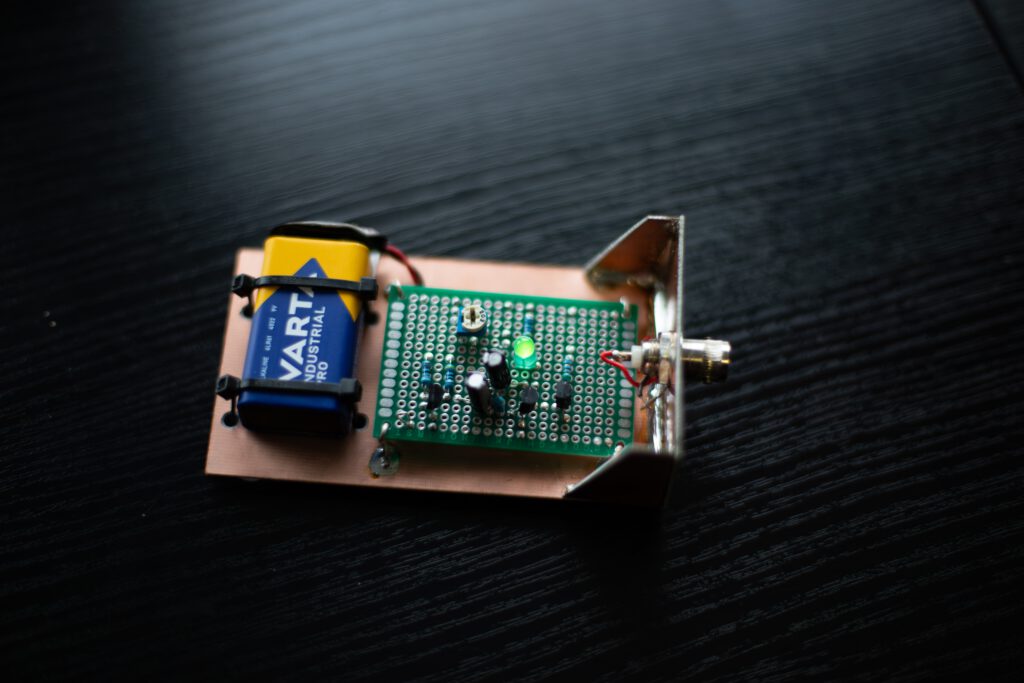
In addition to further optimizing the technology and processes, a goal of the research is to implement SSK receivers on cost-effective hardware, whereby the reduction in costs should facilitate the future widespread adoption of SSK technology. The practical implementation of SSK in the specific application of RFID is still in an early phase of research. The goal here is to put a cost-effective solution into practice.
In addition to RFID transmission, however, there are several other application areas that differ significantly from this. By enabling a change in the standard deviation (hence the name “Sigma”—for standard deviation), i.e., the modulation of the standard deviation, an existing radio link can, for example, be expanded to include the parameter of standard deviation modulation. In short, this allows additional data to be transmitted over the existing data channel.

However, a professorship involves not only aspects of research but also of teaching, namely the transmission of knowledge and skills. Precisely this creative approach to problem-solving, in the sense of a driving force for innovation, can be interpreted as a bridge between the development of Sigma Shift Keying and the fundamental teaching of core engineering competencies, which is particularly relevant at universities of applied sciences. Theory and practice should thus be productively linked to strengthen students’ problem-solving skills. One approach to teaching involves ambitious student projects that combine mechanical and electrical engineering tasks. An example is the design of a sorting machine, for which different groups have found very different ways of implementation. Students can then apply such practical experience in their professional lives.